我的前半生
Chinese scientists develop electrode coating to address signal loss and tissue adhesion problems in long-term brain-computer interface implantation_我的网站

一 | 要特别注意山洪、滑坡、泥石流8月15日14时10分,杭州市气象台发布主城区雷电黄色预警。
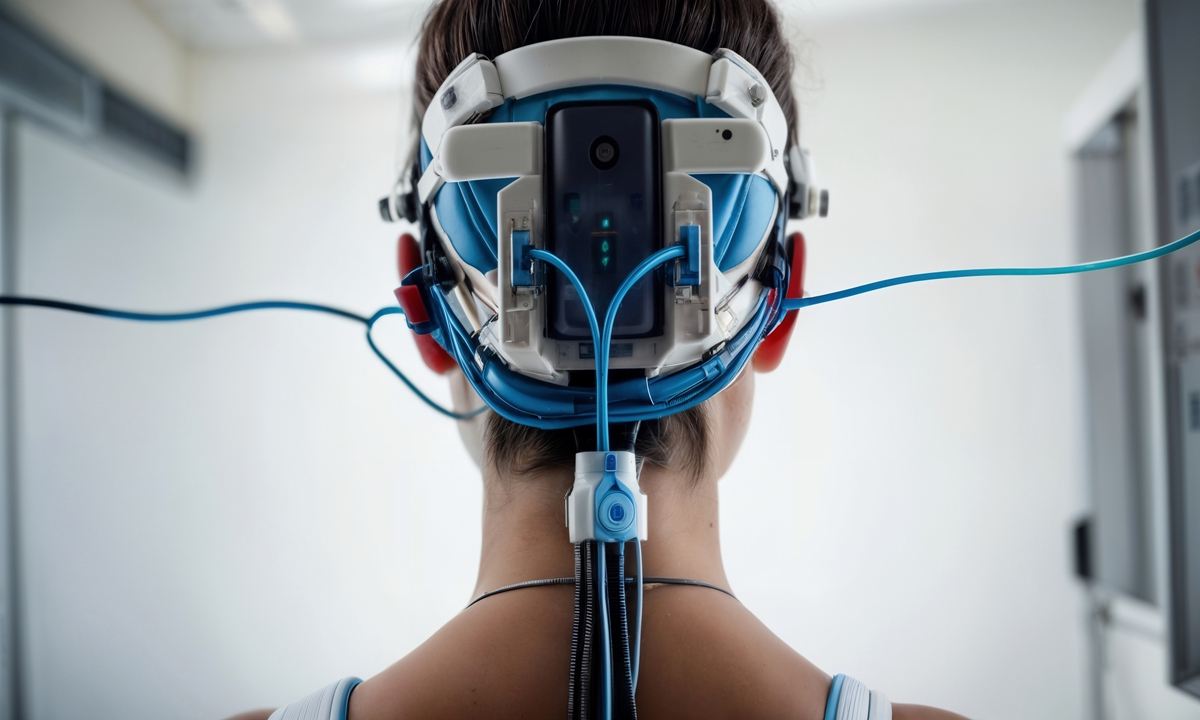
Photo: VCG
Chinese researchers have developed a multifunctional electrode coating that addresses key challenges in long-term brain-computer interface (BCI) implantation, including signal loss and tissue adhesion, bringing BCI one step closer to clinical application, the Global Times learned from the research team behind the findings on Sunday.
As an emerging field combining neuroscience and artificial intelligence (AI), BCI faces a major challenge of ensuring long-term compatibility between electrodes and brain tissue. Previous clinical trials showed that immune responses could cause implanted electrodes to retract after just three months, severely reducing signal quality and the number of available channels.
This problem stems from chronic inflammation triggered by implants, which creates insulating scar tissue around electrodes and separates them from neurons. Irreversible adhesion between electrodes and brain tissue after long-term implantation also makes device removal risky, potentially causing brain injury during follow-up surgeries.
Experiments showed that flexible neural electrodes coated with this material could operate stably in the brain for more than 300 days and could be safely removed without causing damage. This means the universal coating technology can make electrodes not only operate stably over the long term but can also be safely removed and replaced after aging, paving the way for long-term BCI applications.
Developed by the research team led by Zhang Wei at the Technical Institute of Physics and Chemistry, Chinese Academy of Sciences, associated with Beijing Tiantan Hospital, Shanghai Institute of Microsystem and Information Technology and NeuroXess, a high-tech life science company specializing in BCI technologies, the cationic alternating peptide electrode coating preserves electrode flexibility and conductivity, while offering antibacterial, anti-protein adsorption and immune-rejection-inhibiting functions.
A 300-day animal study showed the coating's effectiveness. Bare electrodes experienced a sharp loss of recording capability after 90 days of implantation and could barely detect neuronal signals after 300 days. In contrast, coated electrodes maintained stable recording channels and consistently captured neural signals above 155 microvolts.
In terms of neural modulation, after 300 days of implantation, conventional electrodes required a current of 100 microamps to induce weak limb responses, while coated electrodes triggered clear movements with only 2 microamps, improving modulation efficiency by 50 times.
Notably, the removal tests highlighted a key advantage of the coating that electrodes no longer form irreversible bonds with brain tissue. In the experiments, the coated electrodes were removed intact, with minimal damage to the surrounding brain tissue, Zhang told the Global Times on Sunday.
。

二 | 昨天下午至夜间,杭州多地从中午开始陆续发布雷电、暴雨黄色预警、红色预警信号。8月15日15时02分,淳安县气象台发布雷电黄色预警信号。15时30分将暴雨黄色预警信号升级为暴雨橙色预警信号:近1小时我县瑶山乡何家村、富岩村雨量已接近50毫米,预计瑶山、中洲、浪川、姜家、汾口、枫树岭、安阳、大墅等乡镇未来1小时雨量将达50毫米以上或3小时雨量达75毫米以上。

三 | 23时34分,淳安县气象台又将暴雨橙色预警信号升级为暴雨红色预警信号:近1小时我县大墅镇茅头尖村雨量已达75毫米以上,预计今天夜里我县大墅、安阳、石林等乡镇仍有局地短时暴雨。

四 | 8月15日15时46分,桐庐县气象台将暴雨橙色预警信号升级为暴雨红色预警信号:受强对流云团影响,近1小时新合乡小时雨强已达70毫米以上,预计下午到夜里我县所有乡镇(街道)有短时暴雨,其中新合、江南、凤川局部有大暴雨。8月15日20时52分,建德市气象台将暴雨黄色预警信号升级为暴雨橙色预警信号,预计夜里大同、航头、大慈岩等乡镇有短时暴雨。各地气象台在发布预警时,无一例外在最后提醒广大市民:需特别注意防范短时强降水可能引发的小流域山洪、山体滑坡、泥石流和城乡积涝等次生灾害。
Current article:http://0c9.minpinpengcemiuanjiuxuan.pics/news/20260826_515838.html
Published on:12:31:29


 发表于 01:18:37
 QQ好友和群
 QQ空间
QQ空间 腾讯微博
腾讯微博 腾讯朋友
腾讯朋友 收藏
收藏 支持
支持 反对
反对
 发表于 10:46:04


